
Disclosure: Some links on this page are affiliate links, meaning we may receive a commission if you click
The recent breakthrough by Helion, a pioneering fusion energy startup, signifies a monumental step towards clean and virtually limitless energy. By reaching extraordinarily high plasma temperatures, Helion not only showcases its technological prowess but also positions itself favorably in a highly competitive market, offering a glimpse of a more sustainable future for entrepreneurs everywhere.
“We’re obviously really excited to be able to get to this place,” stated David Kirtley, co-founder and CEO of Helion.
Helion has achieved a notable advancement by utilizing deuterium-tritium fuel in its Polaris prototype, indicating they are the first in the fusion field to reach this fuel milestone. “We observed a substantial increase in fusion power output, specifically in the form of heat,” Kirtley remarked.
Based in Everett, Washington, Helion is amidst a fierce race with other companies vying to commercialize fusion energy—an almost inexhaustible source of clean power. This potential has attracted considerable investment interest. Recently, Inertia Enterprises announced a massive $450 million Series A funding round, while Type One Energy disclosed plans to raise $250 million, and Commonwealth Fusion Systems secured $863 million, with major players like Google and Nvidia on board. Last year, Helion itself raised $425 million from a diverse group of investors.
While many fusion enterprises target the early 2030s to start delivering electricity, Helion is ahead of the curve, having secured a contract with Microsoft to supply power starting in 2028 from its upcoming Orion reactor, rather than the Polaris model.
Each fusion startup operates under unique milestones depending on their reactor design. For instance, Commonwealth Fusion Systems aims to elevate plasmas to 100 million degrees Celsius within its tokamak setup. Helion’s approach requires achieving temperatures nearly twice as hot to meet operational expectations.
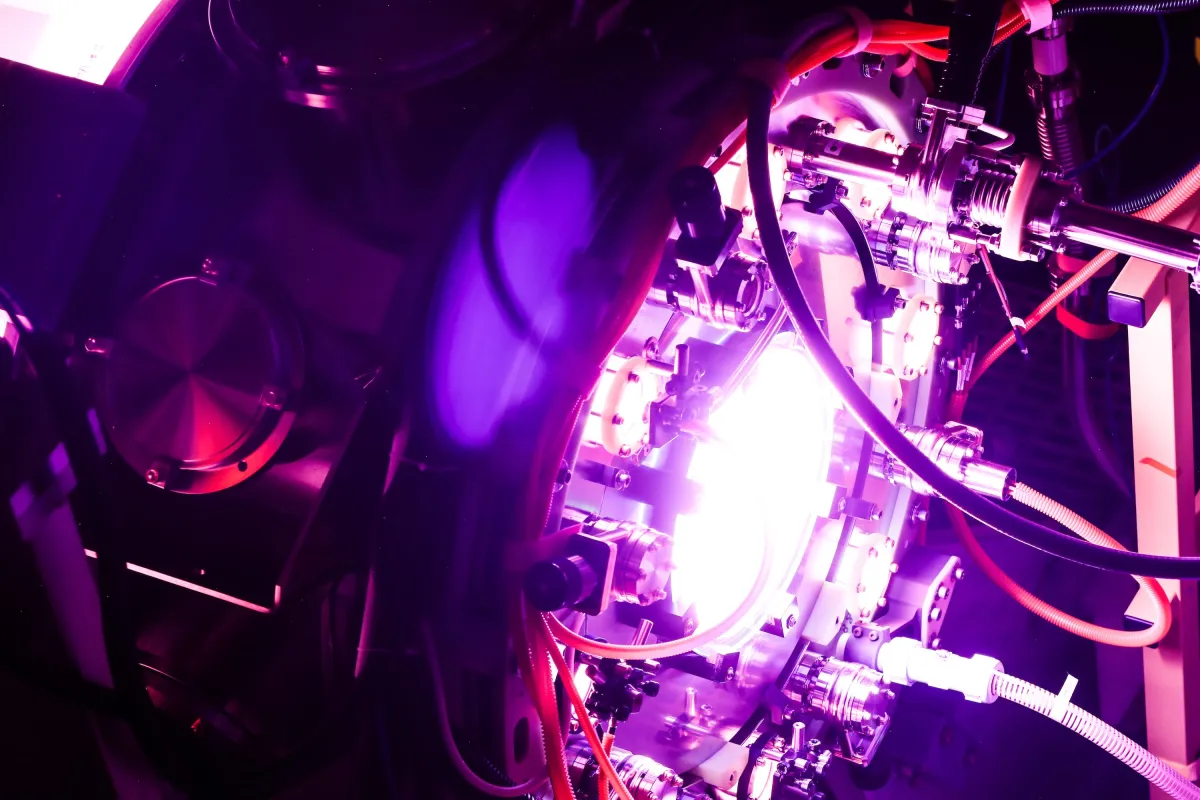
Helion’s reactor features a field-reversed configuration, an innovative hourglass-shaped chamber where fuel is injected, transforming it into plasma. Magnets then drive the plasma toward each other, ultimately merging at temperatures between 10 to 20 million degrees Celsius before being compressed to reach an impressive 150 million degrees in mere milliseconds.
Rather than extracting energy as heat from fusion reactions, Helion’s method harnesses the magnetic field produced during fusion to generate electricity. This technique aims to enhance efficiency over traditional methods. Kirtley has indicated that improvements made to the reactor circuits over the past year have significantly increased the amount of recoverable electricity.
While the company is currently utilizing deuterium-tritium fuel, it has future aspirations to switch to deuterium-helium-3. This fuel variant produces more charged particles, making it particularly advantageous for Helion’s method of direct electricity generation.
Helion plans to achieve plasma temperatures of 200 million degrees Celsius, a goal that is both ambitious and pivotal for operational success. “We believe that reaching 200 million degrees will place us in an optimal zone for running a power plant,” Kirtley elaborated.
When questioned about reaching scientific breakeven—where a fusion reaction yields more energy than it consumes—Kirtley emphasized their focus on electricity production instead of solely hitting scientific benchmarks.
Helium-3, found abundantly on the moon, will need to be synthesized on Earth for Helion’s operations. Initially, the company will fuse deuterium nuclei to create the first batches, with plans for deuterium-helium-3 fusion as the primary energy source during regular operations, supplemented by some deuterium-on-deuterium reactions to generate reusable helium-3.
Kirtley has expressed optimism regarding the fuel cycle advancement, noting that producing helium-3 has exceeded initial expectations in terms of both efficiency and purity.
Currently, Helion stands as the sole fusion startup employing helium-3, but Kirtley foresees interest from competitors as they recognize the benefits of direct electricity recovery. “As other companies realize the advantages of using helium-3, we would certainly be open to supplying it to them,” he noted.
Amidst developments at Polaris, Helion is also constructing Orion, a 50-megawatt fusion reactor needed to fulfill its agreement with Microsoft. “Our ultimate ambition is not merely to launch Polaris but to pave the way for large-scale power generation,” asserted Kirtley.
### Hustle Verdict
Our take is that Helion’s advancements position the company as a leader in the race towards sustainable energy solutions. With a remarkable focus on generating electricity directly from fusion reactions, Helion not only enhances efficiency but also attracts significant investments. The bottom line is, as the demand for clean energy surges, Helion’s innovative approach could redefine market dynamics, offering lucrative opportunities for savvy entrepreneurs ready to embrace the future of energy.